Movements of the United Kingdom’s nuclear weapons increased significantly in 2016 when compared with recent years which suggests that modernised warheads are being introduced into service, according to an annual summary of warhead convoy movements published by Nukewatch (available to download at the bottom of this article).
Evidence from convoy movements observed by Nukewatch is consistent with a programme for loading the first batch of newly modernised warheads on board the Trident submarine HMS Vengeance, which re-entered service during 2016 following a three year refit.
Nukewatch considers that during 2016 at least six loaded convoys travelled between the Atomic Weapons Establishment (AWE) at Burghfield and the Coulport arms depot in Scotland, and at least five loaded convoys travelled in the opposite direction. These are believed to have delivered a total of up to 34 refurbished warheads to Coulport and returned 28 warheads to AWE for modernisation.
Although the total number of convoy movements during the year is similar to the past four to five years, the number of convoys carrying nuclear weapons has more than doubled when compared to previous years, with a corresponding reduction in the number of training exercises.
The pattern of convoy movements observed is consistent with an operation to return warheads equivalent to a single submarine’s complement to AWE for refurbishment. In December 2015 the Trident submarine HMS Vanguard entered Devonport dockyard for a three year refit, prior to which nuclear weapons would have been unloaded from the submarine. At the same time HMS Vengeance left Devonport following a refit, and re-entered service soon after completing a controversial Trident missile test-firing in June 2016, during which an unarmed missile had to be destroyed mid-flight.
Convoy movements suggest that over the first half of the year enough warheads were refurbished by AWE to allow HMS Vengeance to re-enter service in the second half of the year with a largely, if not fully, refurbished complement of warheads.
Production of the modernised and upgraded UK Trident Mark 4A was scheduled to have commenced sometime in 2015 and Nukewatch considers that the convoy movements observed in the first part of 2016 represented an operation to move the first of the Mark 4A upgraded warheads to Coulport prior to loading onto HMS Vengeance.
Over the period 2011 – 2014 a surplus of warheads was returned to AWE when compared with the numbers delivered to Coulport. Nukewatch considers that this is evidence that Trident warheads have been decommissioned at a slow rate in line with a commitment to reduce the number of UK nuclear warheads which was announced in the Strategic Defence and Security Review. Over the last two years this trend has ceased and it appears that there has been a suspension of warhead decommissioning work.
Britain’s nuclear warheads are moved on a regular cycle between the Atomic Weapons Establishment (AWE) in the South of England, where the UK’s nuclear weapons are manufactured and maintained, and the Royal Naval Armaments Depot at Coulport, where warheads are stored prior to deployment on Britain’s Trident submarines. By observing this cycle, it is possible to draw inferences about the level of activity of the UK’s nuclear weapons programme. However, Nukewatch stresses that their figures can only represent an estimate of the true picture.
Jane Tallents of Nukewatch said: “The pattern of warhead convoy movements which we saw last year paints an alarming picture. The evidence suggests that not only are there a greater number of these deadly cargoes on the roads, but that the government is introducing modernised and even more lethal Trident warheads into service.
“While the rest of the world is meeting at the United Nations to draw up a multilateral treaty to ban nuclear weapons, the UK government is unilaterally and illegally modernising its weapons of mass destruction”.
Download annual logs of convoy movements for 2015 and 2016 here:
Convoy log 2015
Convoy log 2016
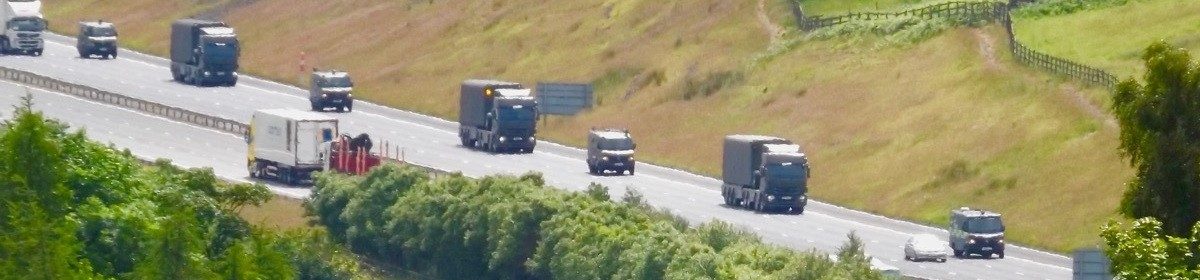

 A convoy of four warhead carriers with all the escort vehicles left Burghfield on the morning of Monday May 15th and headed along the M4 and up the A34 past Oxford. As it was joining junction 9 of the M40 at around 11am it obviously had a problem and pulled over onto the hard shoulder with some of the rear vehicles stopping in a layby still on the A34. The police stopped all the traffic on the slip road so that one of the Mercedes armoured personnel carriers (APC)s could be turned around to face the wrong way and hitched up to the tow truck that travels with the convoy. After 45 minutes the convoy set off up the motorway and the tow truck with APC followed later.
